Register First, Litigate Later: Supreme Court Says Registrar Can't Judge Ownership
Registering a property in India is often one of the most significant financial decisions an individual makes. After years of saving and careful planning, buyers naturally expect the registration process to be straightforward. However, in practice, many purchasers encounter unexpected hurdles, including demands by registration authorities to prove ownership history—something that the law does not ordinarily require.
This issue came under judicial scrutiny in the landmark case of
K. Gopi v. The Sub-Registrar & Others, where the Supreme Court of India clarified an important legal principle: a
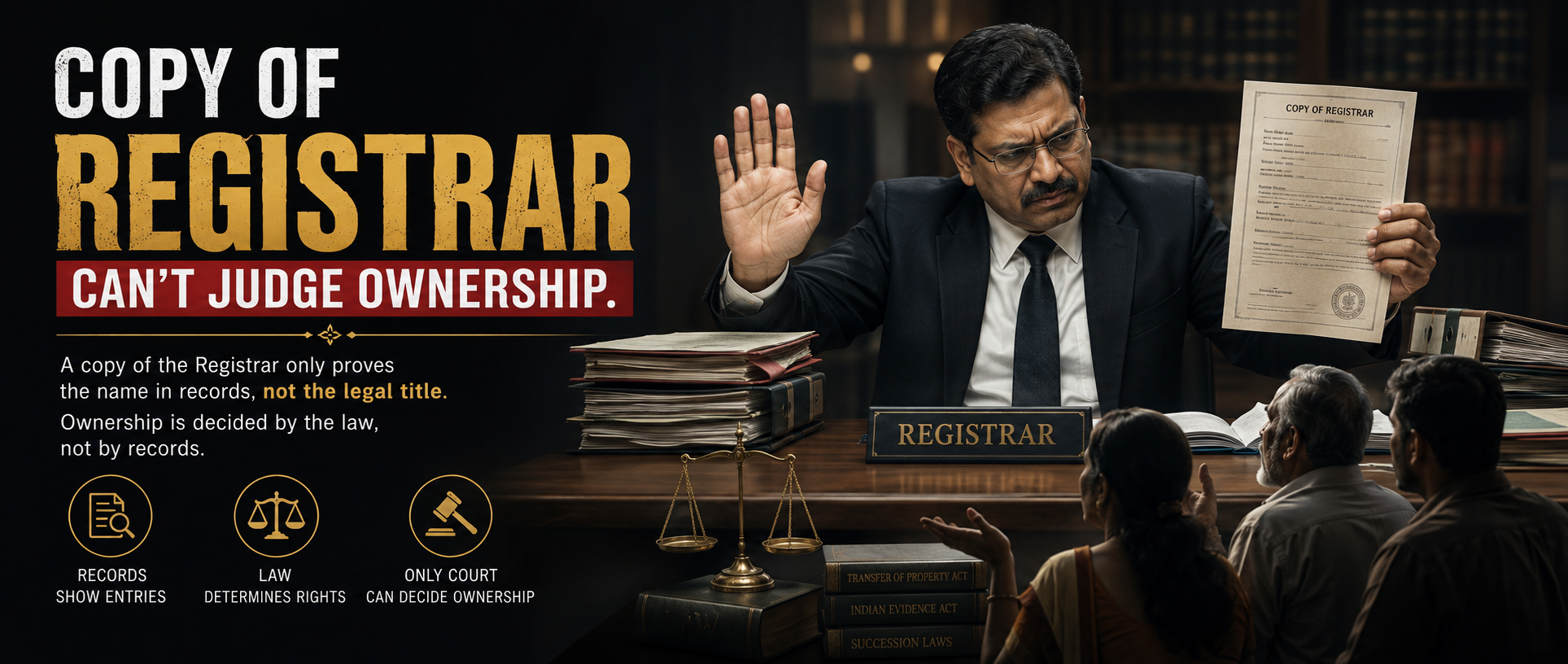
Sub-Registrar performs an administrative function and is not empowered to adjudicate questions of ownership or title. The judgment provides significant relief to property buyers by limiting the powers of registration authorities and ensuring that genuine transactions are not unnecessarily delayed.
Background of the Case
The dispute began when Mr. K. Gopi approached the Sub-Registrar in Tamil Nadu to register a sale deed executed in his favour by Mr. Jayaraman Mudaliyar.
The sale deed fulfilled all statutory requirements, including:
- Proper execution by the parties.
- Payment of the applicable stamp duty.
- Compliance with the procedural requirements under the Registration Act, 1908.
Despite this, the Sub-Registrar refused to register the document by relying upon
Rule 55A(i) of the Tamil Nadu Registration Rules, which required the production of original title deeds or ownership documents before registration.
According to the registration authority, the absence of previous title documents prevented registration of the sale deed.
Journey Through the Courts
After the refusal to register the document, Mr. Gopi initiated legal proceedings.
- A Writ Petition challenging the refusal was filed but was dismissed.
- He subsequently filed a Writ Appeal before the District Registrar, which was allowed, directing the Sub-Registrar to reconsider the matter.
- Despite resubmitting all documents, the Sub-Registrar again refused registration.
- The matter eventually reached the Madras High Court, where relief was denied.
- Mr. Gopi thereafter approached the Supreme Court of India by way of appeal.
The Core Legal Issue
The principal question before the Supreme Court was:
Can a Sub-Registrar examine or determine ownership of a property before registering a sale deed?
The Supreme Court answered this question with a clear and unequivocal
No.
The Court held that the Registration Act, 1908 assigns only an
administrative function to the Sub-Registrar. The Registrar is not authorised to investigate title disputes or determine ownership rights, as such issues fall exclusively within the jurisdiction of competent civil courts.
Understanding Rule 55A(i)
Rule 55A(i) was framed under the Tamil Nadu Registration Rules by exercising the rule-making powers provided under
Section 69 of the Registration Act, 1908.
The Rule required parties seeking registration of certain documents to produce previous title deeds or ownership documents before registration could be completed.
However, the Registration Act itself does not impose such a requirement.
Why Was Rule 55A(i) Declared Ultra Vires?
The Supreme Court held that Rule 55A(i) was
Ultra Vires because it imposed conditions that were not contemplated by the parent legislation.
The Court observed that:
- Subordinate legislation cannot override or amend the provisions of the parent statute.
- Rules framed under delegated legislative powers cannot introduce additional statutory requirements.
- The Registration Act, 1908 does not require production of prior title deeds as a pre-condition for registration.
Accordingly, Rule 55A(i) exceeded the authority granted under the Registration Act and was therefore declared invalid.
Supreme Court's Legal Analysis
The Supreme Court reaffirmed that registration under the Registration Act, 1908 is purely an administrative exercise.
The Registrar's responsibility is limited to verifying procedural compliance, including:
- Proper execution of the document.
- Identity of the parties.
- Payment of the prescribed stamp duty and registration fee.
- Compliance with statutory formalities.
The Court clarified that a Registrar cannot:
- Investigate ownership.
- Decide title disputes.
- Examine competing ownership claims.
- Refuse registration merely because ownership appears doubtful.
Any dispute relating to title must be adjudicated by a competent civil court and not by the registration authority.
Registration Does Not Confer Ownership
The Supreme Court further clarified an important legal principle:
Registration of a sale deed does not itself establish or guarantee ownership.
Registration merely records the transaction in the public records maintained under the Registration Act.
If the seller lacks legal title, registration alone cannot cure that defect or protect the purchaser against future ownership disputes.
Judicial Precedents Relied Upon
To maintain consistency in the interpretation of the Registration Act, the Supreme Court relied upon earlier judicial decisions, including:
- R.R. Kishore v. Sub-Registrar (2009) – holding that registration does not confer title.
- Suraj Lamp & Industries Pvt. Ltd. v. State of Haryana (2012) – reiterating that registration is procedural and is not conclusive proof of ownership.
Relief Granted by the Supreme Court
The Supreme Court allowed Mr. Gopi's appeal and directed the Sub-Registrar to register the sale deed, provided all procedural requirements under the Registration Act were satisfied.
The Court further directed that any dispute concerning ownership or title should be resolved before the appropriate civil court rather than at the stage of registration.
Key Takeaways
- A Registrar cannot refuse registration merely because ownership is disputed.
- The Registrar performs an administrative function and not a judicial one.
- Registration of a document does not create or confirm legal title.
- Property buyers must independently conduct proper legal due diligence before purchasing property.
- Any dispute relating to ownership must be decided by a competent civil court.
- Subordinate legislation cannot override or expand the provisions of the parent statute.
Conclusion
The Supreme Court's decision in
K. Gopi v. The Sub-Registrar & Others is a significant reaffirmation of the limited powers vested in registration authorities under the Registration Act, 1908. By declaring Rule 55A(i) ultra vires, the Court protected citizens from arbitrary administrative practices and ensured that validly executed documents cannot be denied registration merely because questions regarding ownership arise.
The judgment also reinforces an equally important principle: while registration facilitates public record of transactions, it does not determine ownership. Buyers must continue to undertake thorough title verification before completing any property transaction, as registration alone cannot safeguard them against future title disputes.
Ultimately, this landmark ruling strengthens legal certainty, promotes transparency in property registration, and draws a clear distinction between the administrative role of registration authorities and the judicial function of civil courts.