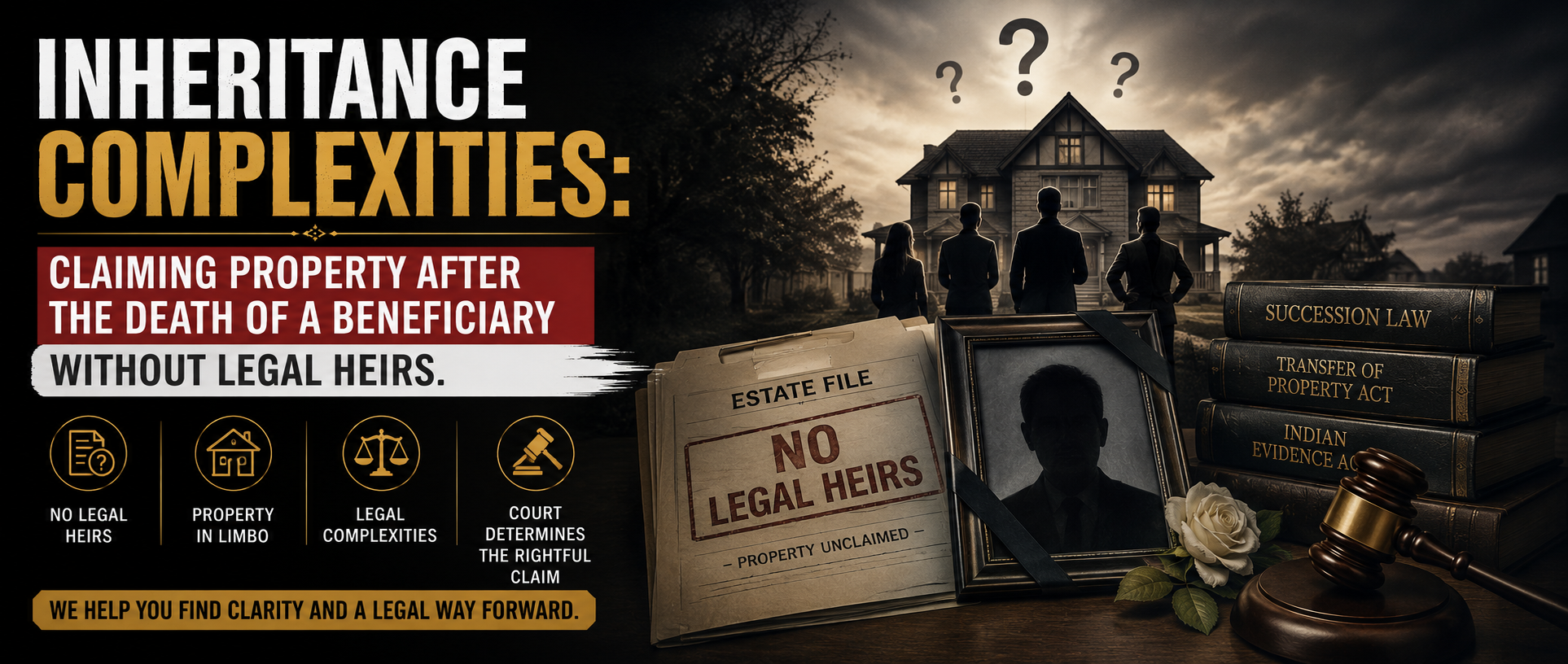
Inheritance Complexities: Claiming Property After the Death of a Beneficiary Without Legal Heirs
Property inheritance can become legally complex when a beneficiary dies without leaving behind a will or any legal heirs. Such situations often raise important questions regarding who is entitled to inherit the property and whether the assets revert to the original owner's estate or pass according to the rules of intestate succession.
To understand this concept better, consider the following scenario.
A Practical Scenario
Mr. A married Ms. B, and they had a son together. After several years, Ms. B passed away due to illness. Mr. A later remarried Ms. C, and the family continued to live together.
Considering his advancing age, Mr. A executed a valid Will in which he bequeathed a substantial portion of his estate to his son from the first marriage and another portion to his second wife, Ms. C.
Following Mr. A's death, the estate was distributed in accordance with the terms of his Will.
However, a legal complication arose when Ms. C subsequently passed away:
- She had not formally transferred the inherited property into her own name.
- She did not execute a Will.
- She left behind no legal heirs who could inherit her estate.
In legal terms, Ms. C died
intestate.
What Happens When a Beneficiary Dies Intestate?
Once a beneficiary inherits property under a Will, that property becomes part of the beneficiary's own estate.
If the beneficiary later:
- Executes a valid Will, the inherited property is distributed according to that Will.
- Dies without leaving a Will, the property is distributed according to the applicable rules of intestate succession.
Under the Indian Succession Act, succession depends upon the nature of the deceased's legal heirs and the personal law applicable to the parties involved.
Where no direct legal heirs exist, questions may arise regarding whether the property can revert to the estate from which it originally came.
Understanding the Doctrine of Lapse
One of the important concepts under testamentary succession is the
Doctrine of Lapse.
The doctrine provides that if a beneficiary named in a Will dies
before the testator, the gift in that beneficiary's favour generally fails or "lapses," unless the Will specifically provides for an alternative beneficiary.
Key Elements of the Doctrine of Lapse
- The beneficiary dies before the testator.
- No substitute beneficiary has been named in the Will.
- The property reverts to the testator's estate and is distributed according to the remaining provisions of the Will or the applicable laws of succession.
Does the Doctrine of Lapse Apply Here?
In the present scenario, the answer is
No.
Ms. C was alive when Mr. A passed away. Therefore, she validly inherited the portion of the estate bequeathed to her.
Since the beneficiary survived the testator, the Doctrine of Lapse does not operate in this situation.
The Doctrine of Reversion or Constructive Lapse
Although the Doctrine of Lapse does not apply directly, another legal principle often discussed in such situations is the
Doctrine of Reversion or
Constructive Lapse.
This doctrine addresses circumstances where the intended beneficiary cannot ultimately retain or transfer the inherited property due to events such as:
- Death after inheriting the property.
- Failure to complete transfer formalities.
- Death without leaving a Will.
- Absence of legal heirs.
In such circumstances, the property may, depending upon the applicable law and facts of the case, revert to the original estate or pass to the next eligible legal claimant.
Key Features of the Doctrine of Reversion / Constructive Lapse
1. Beneficiary Is Unable to Enjoy the Bequest
The doctrine may become relevant where the beneficiary:
- Dies after the testator but before completing the transfer.
- Fails to claim or perfect ownership.
- Dies intestate without legal heirs.
2. Reversion to the Original Estate
Where appropriate, the property may revert to the original estate of the testator or pass to the next lawful heirs according to the Will or the applicable succession laws.
3. Constructive Lapse
The beneficiary's interest is treated as having effectively failed because the property could not ultimately vest in anyone through that beneficiary.
This legal approach helps ensure that property does not remain ownerless or unnecessarily escheat to the Government.
Illustrative Example
Suppose a husband leaves a property to his wife through a Will.
The wife survives him and legally inherits the property but never transfers the property into her own name.
She later dies:
- Without executing a Will.
- Without leaving any legal heirs.
In such circumstances, it may be argued that the beneficiary's rights have effectively come to an end and that the property should revert to the original estate or pass to the next eligible legal claimant.
Application to the Present Scenario
In the present case, the son from Mr. A's first marriage may argue that:
- The property originally belonged to his father.
- The second wife inherited it but died intestate.
- She left no legal heirs.
- The property was never formally transferred into her name.
- Accordingly, the property should revert to Mr. A's estate, where he is already a beneficiary under the Will.
Such an argument is based upon the principles associated with the doctrine of reversion or constructive lapse and the broader rules governing succession.
Alternative Legal Remedy
The son may also seek relief through the process of intestate succession by applying for
Letters of Administration in respect of the second wife's estate, provided no other lawful heirs exist.
If permitted by law and supported by the facts of the case, this process could enable him to inherit the remaining share of the estate.
Conclusion
Inheritance disputes become significantly more complex when a beneficiary dies intestate without leaving behind legal heirs. Although the Doctrine of Lapse does not apply where the beneficiary survives the testator, legal principles such as the
Doctrine of Reversion or
Constructive Lapse may become relevant depending on the facts of the case and the applicable succession laws.
In the scenario discussed above, the son from the first marriage may have a legitimate legal basis to claim the second wife's share of the property by arguing that the property should revert to the original estate or by pursuing appropriate remedies under intestate succession.
Since inheritance disputes often involve complex questions of succession law, testamentary interpretation, and property rights, obtaining professional legal advice is advisable before initiating any legal proceedings.